Have you ever taken a personality test? Recently, I joined friends in an eight-week Myers-Briggs personality course. As a mother of three, my schedule rarely allows for quiet contemplation on the self, but this sounded fun. Our group has taken parenting classes together for years, so we were already comfortable discussing our motivations and tendencies.
All of the material in our class was grounded in scientific research. In fact, the Myers-Briggs personality profiles were derived from Swiss scientist Carl Jung’s studies published in 1921. Katherine Myers and her daughter Isabel Briggs Myers conducted research during the 40’s and 50’s, first publishing their findings in 1962. This stuff is not new.
Lately, I see more articles about personality tests, online questionnaires, or Facebook quizzes related to finding what motives us. I believe it’s appeal as of late, is linked to the current age of information paired with global prosperity allowing for high-tech customization. The latest apps help us find everything from music, food, goods or services that appeal specifically to us. Knowing more about what drives us, helps us to recognize such traits in others, and satisfy our own needs.
The texts for our course included Type Talk by Otto Kroeger and Janet M. Thuesen and What Type Am I? by Renee Baron. I thought they were informative and easy to read. The Baron book offered more visuals, some of which I have included in this post.
We began by learning the four personality divisions:
Introvert/Extrovert: Where you get your energy.
Sensing/Intuition: How you take in information.
Thinker/Feeler: How you make decisions.
Judging/ Perceiving: How you organize your world.
Before our first class, I took the online quiz at [16personalities.com].
I admit to feeling self-indulgent taking time to examine my inner motivations. The skeptic in me compared it to reading my horoscope or taking a Cosmo Quiz. But the truth is, it took 15 minutes, it was free, and it was extremely accurate.
ENFJ Personality (“The Protagonist”)
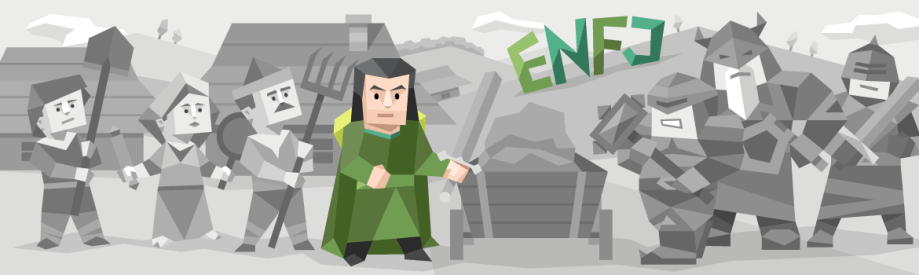
I tested as an ENFJ. (Extrovert/Intuitive/Feeler/Judgement)
I was the only ENFJ in our class of 11 and one of only two extroverts. I share my ENFJ type with President Obama, Oprah and John Cusack. (So why am I not powerful, rich or talented?)
I will describe the characteristics of that go into determining your personality type, according to our text books.
Extrovert/Introvert
Because I am known for being outspoken and unafraid to introduce myself to a room full of strangers, the E, or Extrovert result, came as no surprise to me. When I learned that extroverts get their energy from connecting with people, it all started making sense to me. Extroverts rely on feedback and interplay to help them express their developing ideas out loud. Introverts are better able to listen, interpret and synthesize ideas without having to share or verbalize. They get their energy from one-on-one conversations, small brainstorming sessions, and listening. They are often overwhelmed by their extrovert counterparts who can suck the air out right of a room. Introverts are sometimes accused of being low energy or shy, when in fact, they are busy percolating ideas and strategizing. When prompted to share, they will if the Extroverts let them get a word in edgewise.
Sensing/Intuition
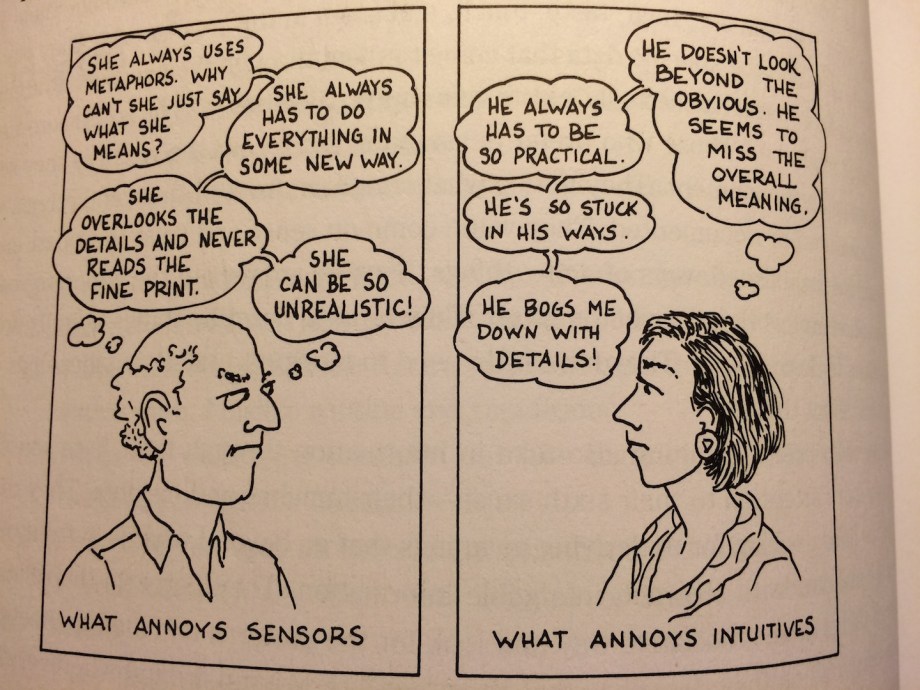
The Sensing/Intuition piece was compelling. The Sensing person takes in information in a concrete, practical way. They draw conclusions based on experience. These are the people who read the instruction manual. They come in handy when toys need assembly or when we are unclear about the rules of a board game. The Intuitive is a big picture guy, moving quickly, relying on hunches, concepts and ideas. They look for patterns and connections between people and things, while the Sensor observes, and is grounded in the physical world. We are all bombarded with information these days, but how we process it differs depending on these personality traits.
Feeler/Thinker
The Feeler/Thinker depictions were easier to ascertain. All 11 of us in class were Feelers, no big news there. (I mean, who takes parenting classes anyway?) The Feelers make decisions based on values. It’s not about empathetic feelings or emotions per se, but whether your values play a role in daily decision making. Thinkers live to solve problems and Feelers want to resolve conflicts by making connections and building relationships. Everything is relational to a Feeler. Thinkers are better able to separate people from issues. They are logical, analytical and systems focused. They don’t take things personally. I am a Feeler and my husband is a Thinker. This often makes for some major miscommunications. Learning about these personality types helped me to see how we are simply wired differently. While all Thinkers feel, and all Feelers think, one of the traits is usually dominant in each person
Judgers/Perceivers
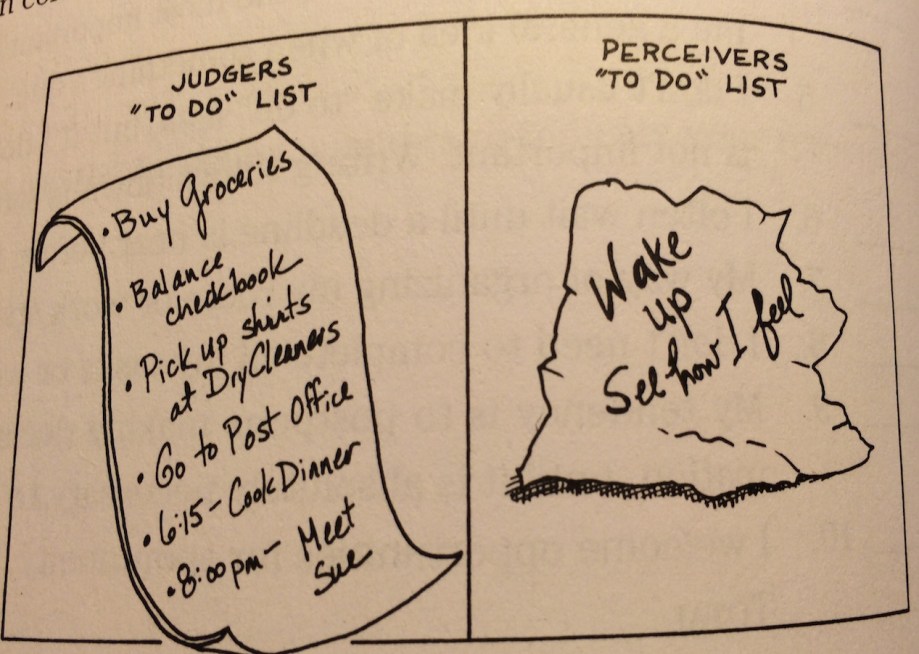
The last category is Judgers/Perceivers. The Judgers are orderly planners. They need to know what is coming next and follow an agenda. The Perceivers are happy just to wing it and see where they end up. They are motivated by pending, future deadlines. Again, there is no right or wrong, but these traits become blatantly obvious when it comes to travel, (think map follower or wanderer?), and dinner reservations (call ahead or take a chance?). I live with the ultimate procrastinator, er…I mean, Perceiver, and that works for him. I am usually cashing my tax refund check before he has even filed his return; nope, no judgment here, simply a matter of preference.
Each week our class discussed how these personality traits factor into our everyday lives and those of our family members. We gained valuable insight from sharing our stories about how different we all are. One thing that each of our textbooks emphasized is that we are naturally attracted to our opposite personality types.
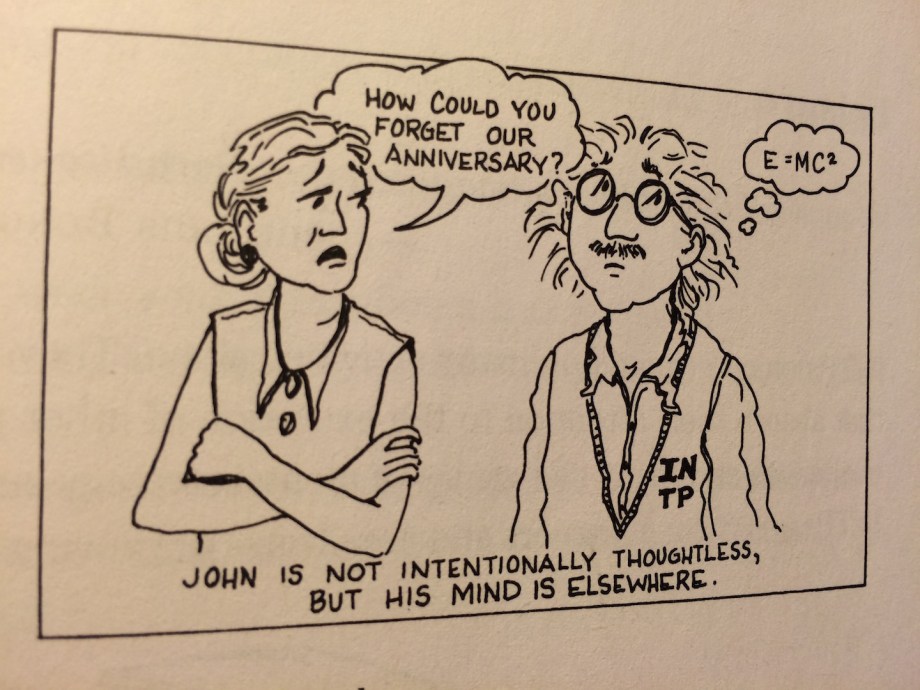
I am glad I took the class. As with anything, I take it with a grain of salt. Of course, the Extrovert/Intuitive/Feeler/Judger in me thinks that examining what motivates me it is worthwhile, so that I might learn to be more accepting and patient when dealing with others. You might want to learn more about your personality traits. You never know, that person who’s not “your type” might end up being your perfect match.
*cartoons courtesy of Renee Baron







 Up On The Roof